
Even a compact residential gun safe can top 600 pounds, and the wrong move can damage floors, vehicles, or people. The good news is that with the right plan and the right gun safe moving equipment, beginners can relocate a safe safely and efficiently. This guide treats the task like any other controlled lift, using basic physics, load ratings, and repeatable procedures to manage risk and effort.
In the steps ahead, you will learn how to assess weight and center of gravity from manufacturer data, clear and protect the travel path, and decommission contents for transport. We will compare core tools, including appliance dollies with ratchet straps, stair-climbing dollies, lift straps, glide skates, ramps, and pallet jacks, and show when to use each. You will size equipment to the load, assign team roles, communicate moves, and maintain three points of control. We will cover thresholds, stairs, and trailer loading, plus final placement and re-anchoring. By the end, you will know the exact sequence, checks, and equipment required to move a gun safe with confidence.
Prerequisites and Essential Tools
Step 1: Verify weight and dimensions to match equipment capacity
Confirm the safe is unloaded, remove ammunition and interior shelves, then lock the door to prevent swing. Locate the manufacturer plate or manual for an accurate weight; as a baseline, small units are roughly 200 pounds, mid-size safes approach 1,000 pounds, and large models exceed 1,000 pounds. With specialized rigging, units up to about 7,000 pounds can be moved, which underscores why ratings matter. Measure height, width, and depth, including handles, hinges, keypads, and any protrusions, and add at least 2 inches of clearance for pads and wraps. Document the weight and the tightest dimension so you can select gun safe moving equipment with an adequate safety margin. For additional sizing and prep tips, see the Allied Van Lines guide on moving gun safes.
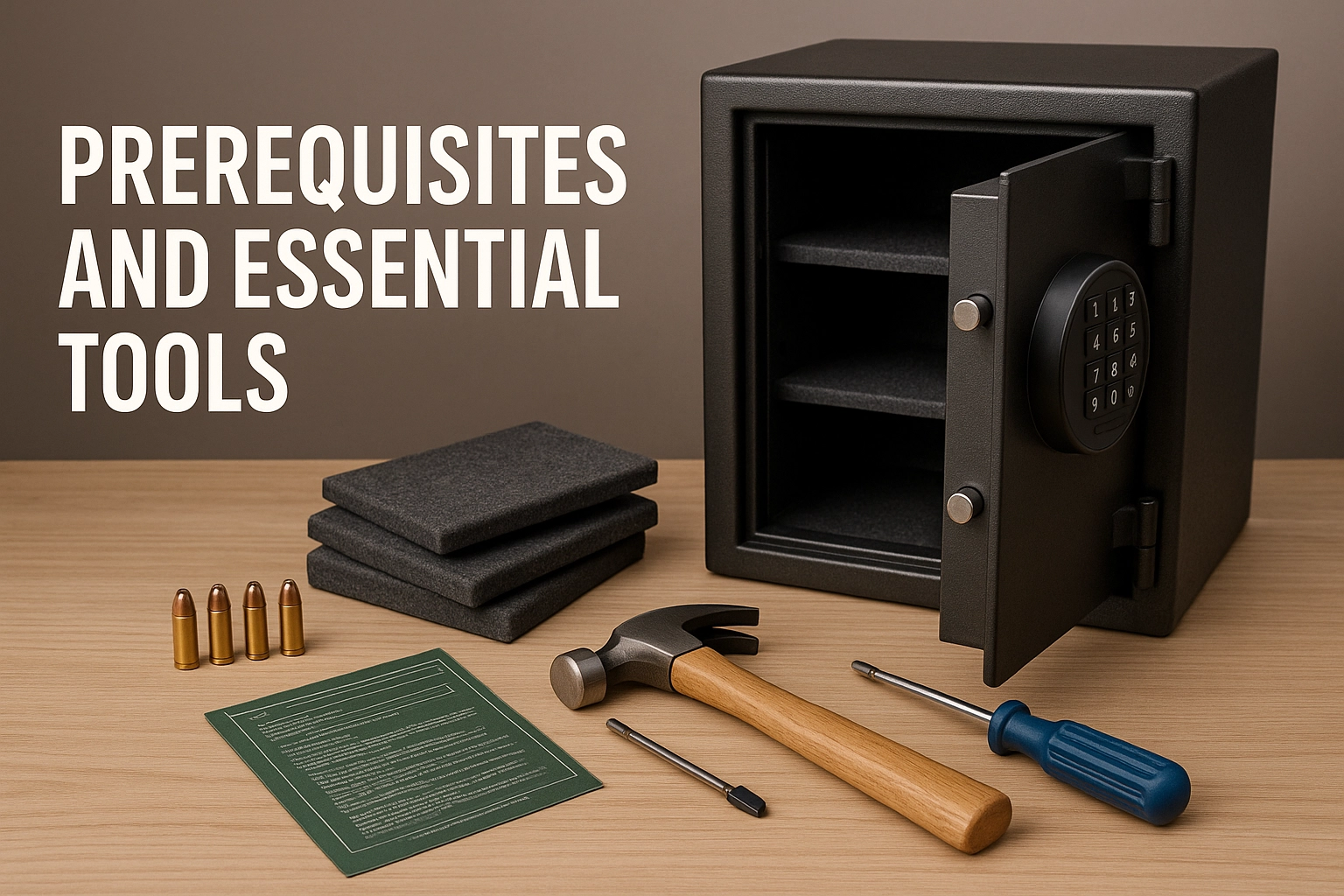
Step 2: Assemble equipment and protective gear with appropriate ratings
Select a heavy-duty appliance or hydraulic dolly rated above your safe’s weight; hydraulic sets commonly support about 3,950 pounds, while some purpose-built gun safe dollies are rated near 1,600 pounds. If stairs are involved, plan on a stair-climbing dolly or a powered solution designed for incline control, as outlined in this guidance on stair-climbing dollies. Use two to four ratchet straps with working load limits that meet or exceed one quarter of the safe’s weight, plus moving blankets and stretch wrap for surface protection. Add furniture sliders, 3/4 inch plywood planks for bridging thresholds, and curb or truck ramps compatible with your dolly. Wear steel-toed boots, high-grip gloves, and eye protection; a back support belt is advisable for beginners. Outcome: your tool set is matched to weight, terrain, and protection needs.
Step 3: Map and prepare the moving path to mitigate obstacles
Walk the entire route from origin to vehicle, measuring the narrowest doorway and hallway. Typical interior doors are 30 to 32 inches, so verify safe width with padding will pass, and plan multi-point turns at tight corners. Protect floors with 1/4 inch Masonite or plywood sheets, and build short ramps to cross one to two step rises. Note slopes, loose rugs, thresholds, sprinklers, and low fixtures, then clear and stage planks in advance. Assign roles for a lead operator, rear stabilizer, and side spotters, and agree on voice commands. Outcome: a documented route that reduces pinch points, floor damage risk, and handling surprises, setting up a controlled, efficient move in the next phase.
Safety First: Preparations and Precautions
Step 1: PPE and grip preparation
Don PPE before any lift. At minimum, wear steel-toe safety shoes, cut-resistant grip gloves, and eye protection, add a hard hat if overhead hazards exist. Back support belts can cue proper body mechanics, hinge at the hips with a neutral spine, but they do not replace sound technique. Follow the Annapolis Safety Manual guidance on PPE to ensure gear is selected, fitted, and used correctly. Inspect gun safe moving equipment before use, rated ratchet straps, corner protectors, and a hydraulic or safe dolly must exceed the safe’s weight. Typical capacities range from about 1,600 pounds for compact safe dollies to roughly 3,950 pounds for hydraulic sets, select at least a 25 percent capacity margin over the loaded safe to account for dynamic forces on ramps and thresholds.
Step 2: Environment hazard assessment
Map the travel path from origin to truck or final room. Measure door widths and turns, clear furniture, rugs, and wall hangings, then install anti-slip runners on tile or hardwood to maintain traction. Dry any spills and sweep debris to reduce slip, trip, and fall risk, maintain bright task lighting in halls and on stairs to improve depth perception. Bridge small thresholds and uneven transitions with 3/4 inch plywood sheets, add shims to remove wobble, and secure edges with tape to prevent catch points. The Rifle, Colorado Safety Manual housekeeping section emphasizes clean, orderly work areas, use it as a pre-roll checklist so your outcome is a continuous, dry, unobstructed path with protected floors and predictable footing.
Step 3: Team communication and synchronization
Conduct a pre-move briefing. Assign a lead at the load end, a rear stabilizer, and a free spotter to watch feet, fingers, corners, and door hardware. Agree on simple commands like Stop, Lower, Raise, Roll, and Hold, use a three-count for every action, and require repeat-back so everyone confirms intent. Practice a dry run without the safe to validate clearances and voice or radio audibility through doorways and stairwells. Establish an immediate stop rule, any team member can call Stop, then reassess anchor points, strap tension, and dolly position before resuming. This disciplined protocol keeps movements synchronized, protects property, and reflects the professional standards Brady’s Moving & Storage follows on every Northern California gun safe move.
Step-by-Step Gun Safe Moving Process
- Prepare the safe by emptying and stabilizing it Remove all firearms, ammunition, documents, desiccants, and accessories to eliminate shifting mass and reduce load. If your model allows, remove interior shelves and door organizers to shed additional weight, then pad and box these separately; many beginners skip this and add 30 to 80 pounds they do not need to move. If the safe includes LED light kits or dehumidifiers, disconnect power and secure loose wiring. Close and lock the door, add a strip of painter’s tape over the dial or keypad to prevent accidental inputs, and strap the handle to stop rotation. If permitted by the manufacturer, engage any transit bolts or internal transport locks. Expected outcome: a stable, lighter cabinet with no internal movement, following guidance similar to how to remove interior components safely.
- Secure the safe to the gun safe moving equipment Match equipment to verified weight: appliance dollies are common, but many residential safes exceed 800 pounds, so consider hydraulic dollies rated up to 3,950 pounds for safer margins. Position the dolly’s toe plate centered under the base, then tilt using controlled leverage while one spotter stabilizes the crown, a technique consistent with this step-by-step positioning method. Wrap moving blankets around corners and faces, add corner guards, then apply two 2 inch ratchet straps rated at or above 1,000 pound working load limit each. Route one strap high across the body and one low through the dolly frame to prevent roll or yaw. Conduct a shake test; any perceptible play means you must retension or add a third strap as a brace, as shown in this 12 step dolly setup approach.
- Maneuver methodically along the planned path Pre-place 3/4 inch plywood sheets to bridge thresholds and protect flooring, and tape down edge ramps to avoid kick-outs. Move in short increments, keeping the center of gravity over the dolly axle, and use clear voice commands like “set” and “roll” with a lead spotter calling turns. For tight corners, micro-rotate by pivoting on a rear caster, then realign before proceeding. On gentle slopes, descend facing uphill with controlled strap tension, never free-rolling. Stairs require rated stair equipment or professional assistance, since commercial rigs are designed to handle multi-thousand pound safes safely. Expected outcome: a slow, controlled traverse with zero wall, floor, or safe damage, ready for secure vehicle loading.
Dealing with Common Challenges
Navigating tight spaces
Tight hallways and 30 to 32 inch interior doorways are common constraints, especially when a safe’s depth plus handle protrusion approaches the threshold. Before you commit to a path, calculate diagonal clearance by comparing the door width to the safe’s smallest face on the diagonal, then plan a controlled tip-and-angle maneuver to gain an extra 1 to 2 inches. Protect pinch points with corner guards and moving blankets to prevent wall gouges and finish damage. Remove door slabs from hinges where needed, and pop baseboards only if necessary, then mark floor protection paths with ram board to prevent point loading. Keep the safe’s center of mass centered over the dolly footprint at all times to avoid a lateral tip. Expected outcome, the safe clears constrictions without wall, floor, or safe damage.
- Measure safe height, width, and depth, plus handle and keypad protrusions.
- Map route clearances, remove obstacles, and pre-pad corners.
- Execute a slow tip-and-angle through doorways with a spotter on the hinge side guiding millimeter-level adjustments.
Troubleshooting equipment issues
Gun safe moving equipment must match the load, typical residential safes weigh 300 to 1,200 pounds while larger commercial units exceed that. Verify dollies and stair aids are rated above the safe’s weight, many hydraulic safe dollies are rated around 1,600 to 3,950 pounds, then confirm straps have a working load limit at least equal to the safe’s weight. Inspect casters for flat spots, axles for play, and bearings for noise, lubricating wheels and pivot points with light lithium grease. Check fastener torque on dolly frames, and confirm tire pressure on pneumatic wheels to manufacturer spec for even rolling resistance. Maintain a pre-move checklist and a post-move log so defects are caught early. Expected outcome, smooth rolling, predictable steering, and secure load retention.
- Pre-inspect and lube wheels, axles, and swivel heads.
- Replace frayed straps and carabiners, never tie knots in webbing.
- Test-brake the dolly under load in a flat area before entering constrictions.
Balancing weight on stairs
Stairs concentrate load onto small treads, so plan for controlled descent or ascent with mechanical advantage and clear commands. Use a stair-capable dolly or track system, keep the safe’s mass centered over the tread nosings, and move one step per command with three-person minimum staffing. Place high-friction runners on treads, then use a top-side lead pulling with straps while a bottom-side bracer stabilizes and prevents sway. For long runs, rig a rated anchor point at the top and add a rope grab or capstan winch for redundant control. Pause to recheck strap tension every 3 to 4 steps and reassess team footing. Expected outcome, steady movement with no sudden shifts and full control on every step.
- Pre-fit the dolly to stair width and verify tread integrity.
- Assign roles, caller, top lead, bottom bracer.
- Advance one tread per command, re-tension straps, and rest as needed.
When a challenge exceeds your comfort level, engage professional gun safe movers in Northern California for specialized tools and trained teams.
Why Professional Help is Often Best
Professional expertise minimizes risk
Moving a safe demands more than strength, it requires trained technique, route planning, and purpose-built gun safe moving equipment. Licensed and insured specialists like Brady’s Moving & Storage deploy crews that are trained to handle high mass, awkward centers of gravity, and confined turns common in Northern California homes and facilities. Typical tools include hydraulic dollies rated for thousands of pounds, stair climbers, machine skates, heavy-duty ramps, and e-track tie-down systems that maintain load control in transit. These controls protect walls, floors, and the safe’s finish while reducing crush and tip hazards. For a seamless, full-service experience that can also include packing and storage, review the scope of Moving Services – Brady’s Moving & Storage. As a licensed and insured operator, Brady’s provides documented coverage and accountability, which you can verify through its BBB Business Profile.
Why DIY attempts frequently fail
A typical residential safe can concentrate more than 1,000 pounds on a footprint smaller than a chair leg, which can punch through subfloors, crack tile, or deform hardwood. Without proper rigging and leverage control, a minor tilt can cascade into a tip event that injures helpers, crushes toes and fingers, or damages stair stringers and railings. Improvised ramps and low-grade hand trucks lack braking and stability features, increasing runaway and drop risks. Even if you avoid injury, shock loads can misalign door frames, damage locking bolts, or compromise fire seals, reducing the safe’s protective value. Professional movers mitigate these risks with load calculations, surface protection plans, and engineered restraint.
Long-distance considerations
Extended transport introduces new variables, including vibration fatigue, thermal expansion, and humidity swings. Professional crews block and brace the safe against rigid surfaces, use load bars with redundant ratchet straps, and pad high-friction points to prevent abrasion. Route plans account for grade, bridge limits, and congestion to minimize dynamic loading, and liftgate trucks with air-ride suspension reduce impact on entry and exit. Climate considerations matter, so movers can add desiccants, wrap with breathable materials, and avoid drastic temperature shocks during unload. Detailed chain-of-custody documentation and placement sketches ensure the safe arrives and is set exactly where specified.
Step-by-step: how to engage professionals effectively
Before you schedule, assemble the right inputs so your mover can engineer a safe plan and accurate quote. 1) Prerequisites, record the make, model, approximate weight, and exact dimensions, plus hallway, stair, landing, and door clearance measurements with photos. 2) Materials needed from you, floor plans or a simple sketch, parking details, elevator reservations if applicable, and any building insurance requirements. 3) Request deliverables, a written scope, confirmed equipment list, and proof of licensing and valuation coverage. 4) Pre-move prep, empty and lock the safe, clear pathways, protect pets and children, and reserve loading zones. 5) Expected outcomes, controlled extraction, secured transit, precise placement, leveling, and post-move inspection with documented condition notes. This preparation sets you up for a controlled, incident-free move.
Brady’s Moving & Storage: Your Trusted Partner
A legacy of precision since 1945
Since 1945, Brady’s Moving & Storage has built a reputation in Northern California for technical rigor, safety culture, and consistent results across residential and commercial projects. The company’s longevity reflects standardized training protocols, documented operating procedures, and continuous equipment upgrades that keep pace with heavier safes and tighter residential layouts. As an established regional provider based in Chico, Brady’s supports local, statewide, and long-distance moves with coordinated logistics and reliable scheduling. Their teams are cross-trained in packing, rigging basics, and property protection so every move follows a predictable plan. For background on the company’s history and scope, see the official profile at Brady’s Moving & Storage, About Us.
Specialized gun safe moving services and equipment
Brady’s specializes in handling gun safes ranging from compact cabinets to full-size units from brands common to Northern California households. Technicians profile each safe by make, approximate weight, dimensions, center of gravity, door swing, and anchoring method, then select the correct gun safe moving equipment for the load. Typical tool sets include heavy-duty appliance and safe dollies, hydraulic dollies rated around 3,950 pounds, lift-assist ramps, low-angle threshold bridges, stair climbers, and tie-down systems. Crews stage floor protection with Masonite and neoprene pads, then guard walls and jambs with corner protectors. Service areas include Chico, Oroville, Yuba City, Marysville, Red Bluff, Orland, and surrounding communities, with routes planned for tight hallways and 30 to 32 inch interior doors.
How Brady’s executes a safe move
Prerequisites, you prepare:
- Unload the safe and lock the door.
- Measure doorways, stairs, and turns; share the tightest width.
- Confirm parking access and path clearance on move day.
- Provide model or estimated weight, and disclose any anchoring.
Materials Brady’s deploys:
- Rated dollies, stair aids, ramps, curb bridges, and straps.
- Floor, wall, and jamb protection; moving blankets and shrink wrap.
Step-by-step:
- On-site survey, weight verification, and route confirmation.
- Stabilize doors, remove loose shelves, and pad-wrap the cabinet.
- Lay floor protection, remove minor obstacles, and guard pinch points.
- Lift with team coordination, strap to dollies, and test roll.
- Navigate thresholds and stairs with spotters and controlled descent.
- Position, level, reassemble interior, and, if requested, anchor to the substrate.
Expected outcomes:
- Controlled handling with reduced tipping risk and surface protection.
- Predictable timelines and clear communication from dispatch to delivery.
- Documented placement and customer sign-off.
Proven results from customers
Reviews consistently cite courteous crews, careful communication, and precise handling from pickup through placement. Clients highlight proactive updates, accurate time windows, and meticulous protection of floors and doorways, even in homes with tight turns or second-story placements. One long-distance customer relocating to Hawaii emphasized the personalized plan and steady updates that removed uncertainty during a complex move. Longtime commercial clients also note reliable budgeting support and schedule adherence for multi-stop projects. This pattern of feedback reflects Brady’s emphasis on planning, the right equipment for the load, and disciplined execution that beginners can trust for high-value safes.
Conclusion: Ensuring a Safe and Smooth Move
Proper preparation and the right gun safe moving equipment are the foundation of a safe, damage‑free relocation. Start by confirming the safe’s unloaded weight and dimensions, then match those numbers to equipment ratings to maintain safety margins. For example, hydraulic dollies are commonly rated around 3,950 lbs, while very large safes can exceed 5,000 lbs and may require specialized rigging practices used for loads up to 7,000 lbs. Protect floors and thresholds with runners, hardboard, and beveled protectors, and keep the center of gravity low with wide‑stance dollies, ratchet straps, and cribbing. Plan a clear, measured route with trained spotters, and distribute point loads with skids or plates when crossing stairs or suspended floors.
Professional movers reduce risk by combining certified techniques, load‑specific tools, and controlled procedures, which translates to fewer surprises and lower total cost of damage and downtime. Costs vary by weight, access, and distance, so an accurate site assessment is essential for budgeting. To plan your next move, follow these steps and document the expected outcome for each: 1) Assess path constraints, floor types, and stair geometry. 2) Confirm safe weight and select rated gear. 3) Decide DIY versus professional service based on risk tolerance. 4) Schedule, secure permits if required, and stage protection. 5) Execute, level, and re‑anchor. The result is a stable, compliant placement with minimal disruption.