Storage customers trust you with more than boxes. They trust you with their identity, their schedule, and their sense of safety. As self-storage portfolios scale, the security conversation shifts from padlocks and cameras to enterprise strategy, data stewardship, and consistent execution across multiple sites. That is where the security self-storage corporate office plays a decisive role, aligning technology, policy, and people to reduce risk while preserving a seamless customer experience.
This analysis explores how modern operators can elevate security by integrating site-level controls with centralized oversight. You will learn how to design an access control stack that unifies gates, units, and identity verification. You will see how video analytics, smart sensors, and audit trails strengthen investigations and deter incidents. We will examine the corporate office playbook, governance frameworks, staff training, and vendor selection criteria that turn tools into reliable outcomes. Finally, we will discuss metrics that prove ROI, from loss prevention to operational efficiency and customer trust. If you manage regional or national facilities and want a practical, scalable path to stronger security, this guide is for you.

The Evolution of Security in Self-Storage
From padlocks to predictive protection
Self-storage security began with simple padlocks, manual patrols, and paper logs. As the value and diversity of stored goods grew, facilities layered defenses with high fencing, bright LED lighting, and CCTV, supported by electronic gates and keypads that timestamp entries. Today, camera systems are augmented by AI analytics that flag loitering, tailgating, and perimeter intrusions in real time, a shift highlighted in top security trends for 2026. Industry case studies report up to 30% fewer break-ins after adopting AI-enabled platforms, a signal that proactive detection outperforms forensic review. Fortress-style buildings, hardened door hardware, and on-site personnel round out the stack, improving tenant safety and satisfaction while streamlining incident response.
How technology is reshaping security protocols
Modern protocols emphasize integration, verification, and continuous monitoring. Facilities increasingly use smartphone credentials and biometrics to reduce shared codes and lost keys; see examples in self-storage access control options. Leading operators are converging access logs, video events, and environmental telemetry into a single pane, enabling rules like, “Alert only if after-hours door activity correlates with motion inside the unit.” Research into a dual-modality IoT framework that unifies access control with environmental safety monitoring shows how cloud analytics can automate these decisions and improve response time. Zero-trust principles are entering the playbook, with device health checks for kiosks and gate controllers, network segmentation between cameras and business systems, and immutable logging for audits. As AI workloads surge in 2026, storing and securing video, access, and alarm data at scale will require efficient retention policies, tiered storage, and tested recovery drills.
Historical lessons, modern challenges, and next steps
Ransomware trends now target storage infrastructure and camera networks, so incident playbooks must include offline backups, least-privilege administration, and timely patching of NVRs, access servers, and corporate endpoints. Planning for post-quantum cryptography helps future-proof sensitive tenant and billing data, especially in a security self-storage corporate office setting where compliance and data trust matter. Modular construction simplifies phased expansions, but designs should pre-wire for added cameras, unit alarms, and lighting zones to avoid blind spots. Actionable priorities include AI-assisted video alerting tuned to local risk, biometric or mobile credentials with strict revocation, quarterly red-team tests at gates and kiosks, and coordinated training for both facility staff and corporate IT. This layered approach protects physical assets, digital systems, and brand trust as threats evolve.
Understanding Key Security Components
Perimeter security, the first line of defense
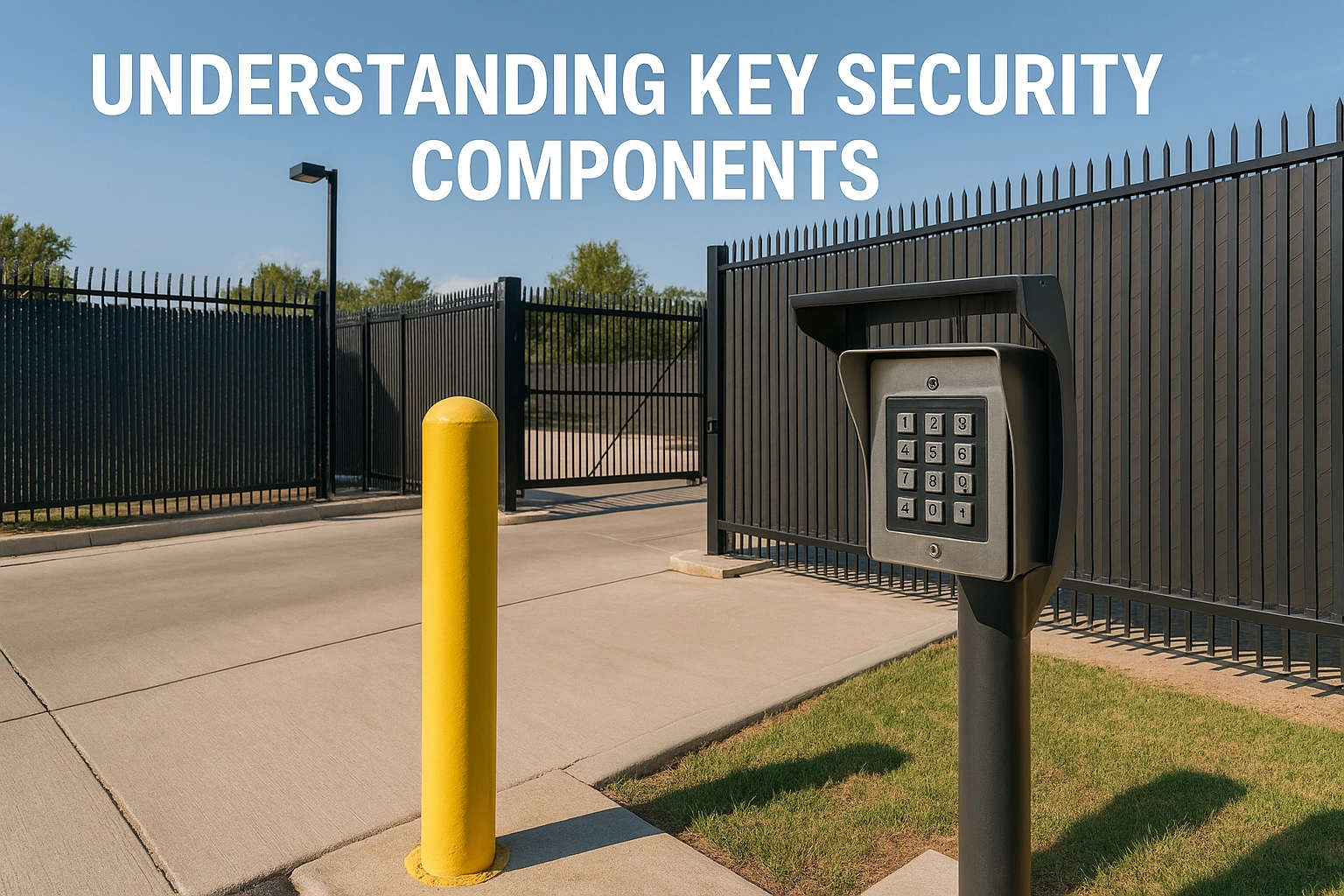
A hardened perimeter is the foundation of loss prevention and tenant safety. Aim for 8 to 10 foot, anti climb fencing with privacy slats, vehicle rated gates, and controlled sally ports at high risk entrances, then couple these barriers with bollards to protect keypad and gate equipment. Lighting is decisive for deterrence and visibility; federal guidance emphasizes consistent illumination around access points and fence lines to support surveillance and patrols, see the Physical Security Guidelines for Bonded Facilities. Layer LED lighting with analytics ready cameras along the perimeter to minimize shadows and blind spots. AI assisted intrusion detection, virtual tripwires, and loitering analytics can trigger real time alerts and shorten response times, as highlighted in trends and best practices for industrial outdoor storage. Conduct quarterly fence line inspections, camera field of view tests, and vegetation control to sustain performance.
Access controls and automated locks
Modern access control determines who enters, where, and when, and it should be centrally administered across all sites. For a security self-storage corporate office, cloud based platforms with mobile credentials enable real time provisioning, instant lockout, and consistent policy enforcement. Combine gate readers or keypads with unit level smart locks to create a two step flow, gate plus unit, that generates a complete audit trail. Best practices include unique, expiring PINs, scheduled access windows, anti tailgating logic, and automated lockouts after failed attempts, as outlined in these security for storage units best practices. Track battery health and signal quality for wireless locks, and run quarterly credential audits to remove dormant users. Verify life safety compliance, including emergency egress and fail secure or fail safe behavior during power events.
Video surveillance prevalence and effectiveness
Cameras remain the backbone of facility security, but results depend on coverage, analytics, and retention. Target 100 percent coverage of gates, keypad areas, and building entrances, add overlapping views of drive aisles and corridors, and maintain 30 to 45 days of searchable footage based on risk and regulation. AI video analytics can reduce false alarms, detect tailgating, and flag after hours activity, with industry deployments reporting up to 30 percent fewer break ins when alerts are paired with trained response playbooks. Integrate video with access and alarm events so denied credentials, door forced, or unit tamper instantly bookmark footage and notify staff. Enhance deterrence with visible signage, bright LED lighting, and documented response timelines that move from detection to dispatch within two minutes. Validate performance with periodic heat map reviews and scenario based drills, especially after layout changes or expansions.
The Role of AI and Software Solutions
AI-driven storage architectures
AI is reshaping how portfolios monitor and harden facilities, from cameras to electronic gates. Computer vision can flag loitering, tailgating, or suspicious vehicle dwell times in real time, then escalate only high-confidence events to staff. Industry case studies report up to 30 percent fewer break-ins when AI video analytics and automated alerting are deployed, a direct win for loss prevention and tenant safety. For a security self-storage corporate office overseeing multiple sites, AI also predicts maintenance for cameras, door alarms, and network video recorders, which reduces downtime and truck rolls. At the data layer, AI-ready arrays such as IBM FlashSystem illustrate how policy automation, placement, and replication can protect and mobilize surveillance data across sites. With AI workloads driving storage demand in 2026, hybrid agility and intelligent tiering keep costs in check while preserving evidentiary video quality.
Cloud-integrated solutions for efficiency
Cloud platforms unify access control logs, video health, and incident workflows across regions, enabling a lean corporate team to manage dozens of facilities. Recent industry rollouts, such as cloud-based analytics built on Microsoft Fabric, show how centralized dashboards convert raw events into heatmaps, risk scores, and staffing priorities. Adoption is accelerating, with 45 percent of facilities implementing AI-driven automation and 60 percent of inquiries handled by chatbots, which has cut staffing needs by 30 percent and improved responsiveness for after-hours security questions, according to sector statistics (AI in self-storage statistics). Cloud integration also simplifies over-the-air firmware updates, certificate rotation, and multi-factor access for vendors, all essential to reduce cyber exposure. Actionable tip: standardize a cloud-native playbook that maps each alert type to a workflow, a service-level target, and an audit trail.
Software-defined solutions and their impact
Software-defined storage decouples software from hardware, creating a single control plane for video archives, access logs, and IoT telemetry. This flexibility matters as footage scales from 1080p to 4K and as retention policies expand from 30 to 365 days for investigations and insurance. The SDS market is growing rapidly, with projections from roughly 80.6 billion dollars in 2026 to about 684.4 billion dollars by 2035, reflecting a 26.9 percent CAGR, a signal that cost-optimized, policy-driven storage is becoming mainstream. For security operations, SDS enables immutability for evidentiary video, automated lifecycle tiering to low-cost cloud, and instant failover to maintain recording continuity during outages. To execute, start with a data map of every security data stream, require open APIs, enforce zero trust segmentation, and test quarterly failover drills. These foundations let corporate teams scale protection, improve MTTR, and quantify ROI across the portfolio.
Addressing Commercial Theft Threats
Understanding organized commercial theft
Organized groups are escalating from opportunistic pilferage to coordinated, high value raids on supply chains and storage nodes. In 2025, cargo theft losses in the United States and Canada were estimated at about 725 million dollars, a 60 percent jump year over year, and the average loss per incident climbed to roughly 273,990 dollars. California remained the hottest spot with more than 1,200 cases, while activity spread into interior counties like Kern and San Joaquin. Thieves increasingly pursue easily fenced goods such as food and beverage, high demand metals like copper, and enterprise computing hardware.
Implications for storage facility owners
For storage facility owners, this shift raises risk exposure across both units and the corporate office. A single coordinated breach can erase margins for a quarter, disrupt operations, and trigger premium hikes at renewal. Facilities in Northern California, where incident volumes are elevated, should assume adversaries conduct reconnaissance, use cloned credentials, and exploit tailgating during peak hours. Practical responses include hardening high value zones, auditing blind spots after dusk, and testing response times. Documented incident playbooks and multi party drills reduce confusion, accelerate law enforcement engagement, and preserve tenant confidence when seconds matter.
Traditional vs modern security solutions
Traditional measures, fences, padlocks, static CCTV, and floodlights, deter casual thieves but lag against organized crews. Modern programs integrate 8 to 10 foot anti climb fencing, LED lighting with adaptive schedules, individual door alarms, and electronic gate access with unique, expiring codes. Computer vision that flags loitering, tailgating, and license plates has helped large operators cut break ins by roughly 30 percent, especially when paired with audio talk down and rapid guard dispatch. Extend security to the self storage corporate office, enforce multifactor login to access control software, segment camera networks, and patch NVRs on a strict cadence.
Case Study: Brady’s Moving & Storage Security Innovations
Overview of Brady’s security protocols and solutions
Brady’s Moving & Storage secures assets with a multi layer program that combines physical, electronic, and procedural controls. Perimeter defense uses high fencing, LED lighting, monitored CCTV, and electronic gate access with tenant specific PINs and computer controlled door alarms, aligned with perimeter and access control best practices for storage facilities. High definition cameras record 24 hours a day across entrances, corridors, loading docks, and the corporate office lobby to create a verifiable audit trail. Spaces are segmented so warehouse floors, yards, and administrative zones operate on least privilege access. Sensitive inventories sit in climate controlled rooms held near 65°F and about 65 percent humidity, documented at climate controlled storage unit specifications.
How advanced security measures benefit clients
These controls deliver clear client benefits. AI assisted video analytics and alerting, a leading 2026 security trend, have reduced break ins by roughly 30 percent in similar environments, which lowers loss exposure and bolsters tenant confidence. Clients also gain convenient, safer access through gated keypads and illuminated paths, while tamper evident logs streamline claims and audits. For commercial accounts, Brady’s extends protection to digital systems in the corporate office with multi factor authentication, endpoint hardening, and network segmentation, following cybersecurity guidance for self storage businesses. The approach aligns with AI driven intelligence and hybrid agility, preparing operations as AI workloads expand.
Examples of successful security implementations
Implementation discipline turns policy into outcomes. After a tailgating review, Brady’s added license plate coverage and configured gate logic to pause entry when two vehicles approach on one credential, which stopped repeat attempts and generated teachable moments for tenants. A quarterly audit found a dim loading dock corner; one camera move plus LED lighting and tuned motion zones improved night visibility and cut nuisance alarms. Inside the corporate office, a phishing tabletop drove company wide MFA and a privileged access review. The result is a security self-storage corporate office program that is preventive and continually refined.
The Future of Self-Storage Security
Predictions for technological advancements in security
Security in self-storage is shifting to AI native operations that fuse cameras, access control, and building systems. Computer vision with license plate recognition and behavior analytics will flag tailgating or perimeter breaches in real time, then lock zones or alert staff. Mobile and biometric credentials will replace keypads, while IoT sensors track door status, vibration, temperature, and humidity. Video will move to hybrid storage, with days on camera and months in cloud tiers, matching the surge in AI workloads that is driving enterprise storage growth in 2026. Early adopters report roughly 30 percent fewer break-ins.
Potential challenges and solutions for facility owners
The biggest headwind is cyber risk, since gate controllers, cameras, and point of sale systems are IP connected; one phish to a corporate office user can expose access databases. Mitigation should include MFA, network segmentation between guest Wi-Fi, operations, and security, quarterly firmware patching, and continuous monitoring with playbooks. Biometric privacy adds duties like consent, retention limits, and encryption, so choose vendors with policy based governance and audit logs. Cut integration pain by piloting at one site, requiring open APIs, and using modular construction to prewire power and mounts. Protect security across self-storage corporate office systems as rigorously as the yard.
The role of Brady’s Moving & Storage in setting standards
Since 1945, Brady’s Moving & Storage has applied multilayer controls that combine perimeter hardening, smart access, and disciplined procedures, helping set higher expectations for Northern California facilities. The team emphasizes measurable programs such as incident tracking, response time targets, and periodic drills that test tailgating and credential misuse. Sites pair LED lighting, tamper resistant office furnishings, and AI assisted video analytics with on site personnel and clear escalation SOPs. On the digital side, Brady’s enforces role based access, documented backups, and clean data practices. By sharing practical checklists and standardized specs with partners, Brady’s helps raise the regional bar.
Conclusion: Securing the Future
What the analysis showed
Securing self-storage and the corporate office that runs it now requires a unified program that blends hardened perimeters, intelligent access control, and AI-enabled monitoring with strong cybersecurity. Facilities that combine video analytics, unit door alarms, LED lighting, and on-site personnel report fewer incidents, with AI security platforms associated with up to 30 percent reductions in break-ins. At the corporate layer, zero trust access, multifactor authentication, and vigilant monitoring protect billing systems, tenant data, and remote facility controls. Industry signals point to rapid change, with 2026 projected as a standout year for enterprise storage as AI workloads accelerate and hybrid architectures mature. Modular construction is also reshaping capital plans, allowing operators to add secure wings, hardened vestibules, or tech-ready command spaces faster and with less disruption.
How to act now
Start with a security maturity assessment that scores physical, electronic, and cyber controls, then prioritize fixes that cut risk fastest. Pilot computer vision for tailgating and loitering at a single gate, measure false alarms and incident reductions, and scale if performance meets targets. Integrate keypad or credentialed access with your management software to tighten audit trails and automate offboarding. Standardize tamper-resistant materials and locksets in the corporate office, and encrypt portable media used in operations. Establish quarterly drills, tabletop exercises, and vendor risk reviews; track KPIs such as incidents per 1,000 units, mean time to respond, and tailgating rate. Finally, align 12 to 24 month budgets to 2026 trends, reserving funds for AI analytics, cyber hardening, and modular retrofits. With a proactive posture and continuous learning, Brady’s Moving & Storage can sustain tenant trust and safeguard assets as threats and technologies evolve.