Introduction
Why storage demand is rising in Oakland
Oakland’s urban density, home price resilience, and the growth of remote work are pushing more residents and small businesses to seek flexible space. As of December 2025, a typical 10×10 unit averaged $196 per month in the city, up about 4.3 percent year over year, according to Oakland self storage prices and construction trends. That upward nudge reflects steady demand from movers, downsizers, and e-commerce sellers needing micro warehousing. For beginners comparing storage units in Oakland, start by defining your use case. A short remodel, a summer sublet, or seasonal inventory each drives different requirements for access hours, loading convenience, and protection level.
Compare options, price trends, and sustainability signals
Evaluate feature sets side by side. Drive-up units offer car-to-door speed, good for frequent access, while interior or climate-conditioned spaces add protection for electronics, records, and upholstered goods. Right-size by listing items and measuring the largest pieces, then match to common footprints like 5×10 for studio overflow or 10×10 for two bedroom contents. Choose drive-up for frequent visits, select interior climate for preservation, and opt for upper-floor units when price is the priority. Nationally, self storage rents have stabilized, rising about 0.3 percent year over year to roughly $16.32 per square foot as supply holds steady, per a CRE Daily market brief. Sustainability is also reshaping facility choices, with operators adopting LED lighting and solar to trim costs and appeal to eco minded customers. In the next section, we break down the most common options in a clear side by side comparison.

Criteria for Storage Unit Selection
Cost, location, and accessibility
Cost, location, and accessibility are the first levers to compare when choosing storage in Oakland. Street rates vary by neighborhood and amenity, with a typical 10×10 averaging about 204 dollars per month on Oakland storage listings. Units near Downtown or major freeways reduce drive time but often carry higher prices, while farther neighborhoods can be cheaper. Factor accessibility too, 24 hour access and drive up doors add convenience for frequent visits, but they usually raise storage units Oakland pricing.
Security and climate control
Security should be a deciding factor, especially for higher value items. Prioritize gated entry, ample lighting, camera coverage, on site staff, and unit level alarms, features commonly highlighted in secure Oakland storage options. Climate control deserves equal consideration because coastal humidity can warp wood, corrode electronics, and damage artwork or records, and it typically costs 20 to 50 percent more according to this overview of climate controlled storage costs and benefits. Choose security first for tools and inventory with easy replacement, choose climate control first for heirlooms, media, instruments, and business archives.
Unit sizes and special features
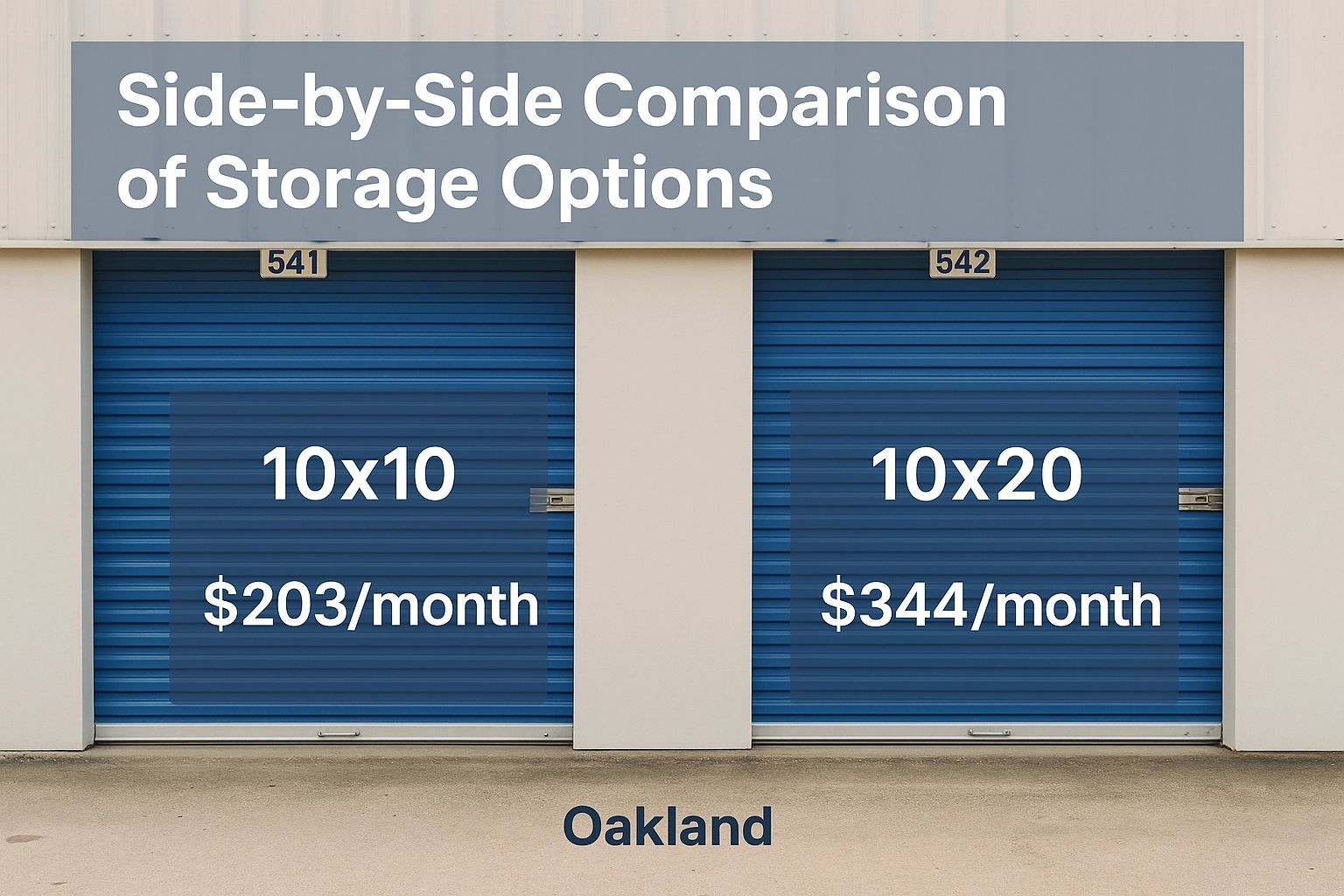
Right sizing prevents overpaying. A 5×5 fits seasonal boxes, a 5×10 handles a studio, a 10×10 suits most one bedroom contents, and a 10×20 accommodates multi room moves. Pricing scales quickly, Oakland 10×10 units average about 204 dollars while 10×20 options often range from roughly 344 to 410 dollars depending on location, climate settings, and access. Match features to use case, drive up and 24 hour access serve contractors and e commerce sellers, interior climate controlled floors better protect furniture, documents, and long term storage. Brady’s Moving & Storage can also advise on right sizing and timing to reduce total trips.
Side-by-Side Comparison of Storage Options
Standard prices at a glance
Begin with size based baselines. A 10×10 in Oakland averages about 203 dollars per month, keeping the city above the 200 dollar threshold, see Oakland 10×10 pricing. A 10×20 has historically averaged near 344 dollars, though early 2026 quotes show some listings around 410 dollars for similar footprints, see Oakland 10×20 averages. A 10×15 often prices near 292 dollars, offering middle ground if your items stack efficiently. Differences usually reflect climate control, ground floor access, security level, and neighborhood demand, so plan a modest premium for added amenities.
Where discounts create savings
Promotions can significantly lower effective rent when they match your timeline. Typical offers include first month free or half off, prepay savings, and autopay or referral credits. For example, a 10×20 quoted at 410 dollars with a first month free promotion over three months totals 820 dollars, about 273 dollars per month. On longer terms, a 10 percent prepay on a 10×15 at 292 dollars saves about 175 dollars over six months, and ongoing softness in national street rates since 2024 supports polite rate review requests. Time your start date mid month to capture prorated rent and pair it with move in credits.
Added support from Brady’s Moving & Storage
Total value also includes how smoothly you move in and out of the unit. Brady’s Moving & Storage services cover packing, loading, unloading, and secure storage handling across Northern California. Coordinating unit access with professional loading can reduce trips, protect fragile items, and right size your space so a well packed 10×10 replaces a 10×15. Ask Brady’s to confirm Oakland availability and provide an itemized, bundled estimate, helping you compare total costs with confidence.
Recommendations for Choosing the Right Storage
Align storage with your needs and budget
Start by listing everything you plan to store, then group items by size and fragility to estimate cubic footage. A simple rule is to choose a unit that fits your estimate with a 10 to 15 percent buffer so you avoid paying to upsize later. If you are storing furniture sets, bikes, or inventory racks, compare a 10×15 to a 10×20, as Oakland’s largest 10×20 units average about 344 dollars per month, a premium over state and national norms. Because self storage street rates fell 4.3 percent nationally in February 2024, ask about current promotions, prepay discounts, or free lock offers at storage units in Oakland. If you are storing electronics, instruments, or artwork, review climate control and humidity guidance from expert checklists like these tips on facility features, see what to know before choosing a facility.
Plan for the next 6 to 18 months
Think about events that could change your space needs, such as a remodel, a cross town move, or seasonal sales if you run an online shop. The self storage footprint reached about 2.1 billion square feet in 2025, signalling ample capacity, yet tight Bay Area submarkets can shift quickly. With a 1.2 percent home price uptick in 2025, many residents postpone moves, which can keep local storage demand firm, so build flexibility into your plan. Favor month to month terms, clear upgrade or downgrade paths, and ask whether you can switch unit sizes without new admin fees. If access will be infrequent, choose an upper level unit to save, then maximize value with vertical shelving, labeled bins, and a simple aisle map.
Consider comprehensive service providers
Decide whether you prefer do it yourself access or an integrated move and store experience. Full service providers can combine professional packing, pickup, secure storage, and delivery, which reduces handling risk and saves time during remodels, relocations, or business expansions. For a streamlined option backed by decades of Northern California experience, consider Brady’s, see Brady’s Moving & Storage BBB profile. Ask for a written inventory, valuation options, and a single invoice covering moving plus storage to simplify budgeting. Share your item list and target duration, then request right size recommendations and any long term rate protections to keep costs predictable as your needs evolve.

Impact of New Regulations and Trends
What Oakland’s 2026 sustainability codes mean for storage
Oakland has adopted amendments to California Title 24 that take effect January 1, 2026, emphasizing electrification, wildfire and seismic resilience, and sustainable construction. For storage units Oakland operators, this means permit-triggering projects, even modest retrofits, will increasingly need electric HVAC, LED lighting with controls, and greener materials, plus detailing for fire hardening and updated seismic anchorage. The timing coincides with macro trends. Self storage has expanded to 2.1 billion square feet nationally by 2025, yet street rates fell 4.3 percent in February 2024, pressuring margins as California rents and utilities rise. Locally, a 10×10 averages about 203 dollars per month and a 10×20 around 344 dollars, so facilities must balance higher build standards with competitive pricing. Facilities planning new phases or major rehabs should review Oakland’s specific amendments and compliance checklists early in design, see City of Oakland building code updates for 2026. Given a 1.2 percent rise in home prices in 2025 and persistent e-commerce storage demand in Northern California, sustainability compliance can double as a market differentiator if executed cost efficiently.
Strategic choices, side-by-side: retrofit vs. rebuild, and tech investments
Retrofit versus rebuild. Retrofitting an existing single-story drive-up site often costs less upfront and keeps units rentable, but envelope losses and older layouts can limit energy gains. Rebuilding or adding a multistory climate-controlled building raises capital cost, yet tighter envelopes, shared walls, and vertical circulation typically improve energy intensity and land use. Electrification options. Heat pumps can deliver 2 to 3 times the efficiency of older gas units; pairing with LED plus sensors can cut lighting energy 40 percent or more, often yielding 3 to 6 year paybacks. Resilience investments. Seismic bracing for racking, upgraded fire-rated assemblies, defensible landscaping, and ember-resistant vents reduce risk and can stabilize insurance costs. Action plan. Run a facility energy and resilience audit, model total cost of ownership over 10 to 15 years, then compare scenarios: a phased retrofit that targets 20 to 30 percent energy savings, versus a code-compliant rebuild that adds premium climate-controlled inventory. Use local and federal incentives to buy down electrification and controls, then align pricing tiers to demand, for example premium climate control for inventory-sensitive users, while maintaining competitive rates on standard units. This structured comparison helps operators serve today’s customers while preparing for Oakland’s 2026 code horizon.
Conclusion and Actionable Takeaways
Make informed choices
Choosing storage units in Oakland works best when you balance size, price, and access with clear math. Start by inventorying everything, then estimate cubic footage and leave 10 to 15 percent headroom to avoid upsizing later. Use price anchors to compare options: a 10×10 averages about 203 dollars monthly in Oakland, while a 10×20 averages around 344 dollars, so right-sizing can save over 1,600 dollars a year. Track market context too. National street rates fell 4.3 percent in February 2024, yet local demand remains tight as home prices edged up 1.2 percent in 2025 and self storage expanded to more than 2.1 billion square feet, see the national self storage statistics.
Actionable takeaways with Brady’s Moving & Storage
Thorough comparisons pay off when paired with execution. Brady’s Moving & Storage helps you transition seamlessly with pre-move sorting, photo inventories, and labeling, then delivers, stacks, and optimizes your unit for vertical use to unlock 15 to 25 percent more capacity. For example, a remodeling family can stage furniture in a 10×10 for one quarter, while a growing e-commerce seller can consolidate seasonal pallets into a 10×20 to avoid extra last-mile trips. Our team aligns unit selection with your timeline, security needs, and access hours, and we schedule pickups to match building rules and loading zones. The result is fewer surprises, lower carrying costs, and a storage plan that adapts as Oakland’s pricing and regulations evolve.